

Studies Index
Participate In Our Research
Studies Index
Participate In Our Research
Active Studies Enrolling Now

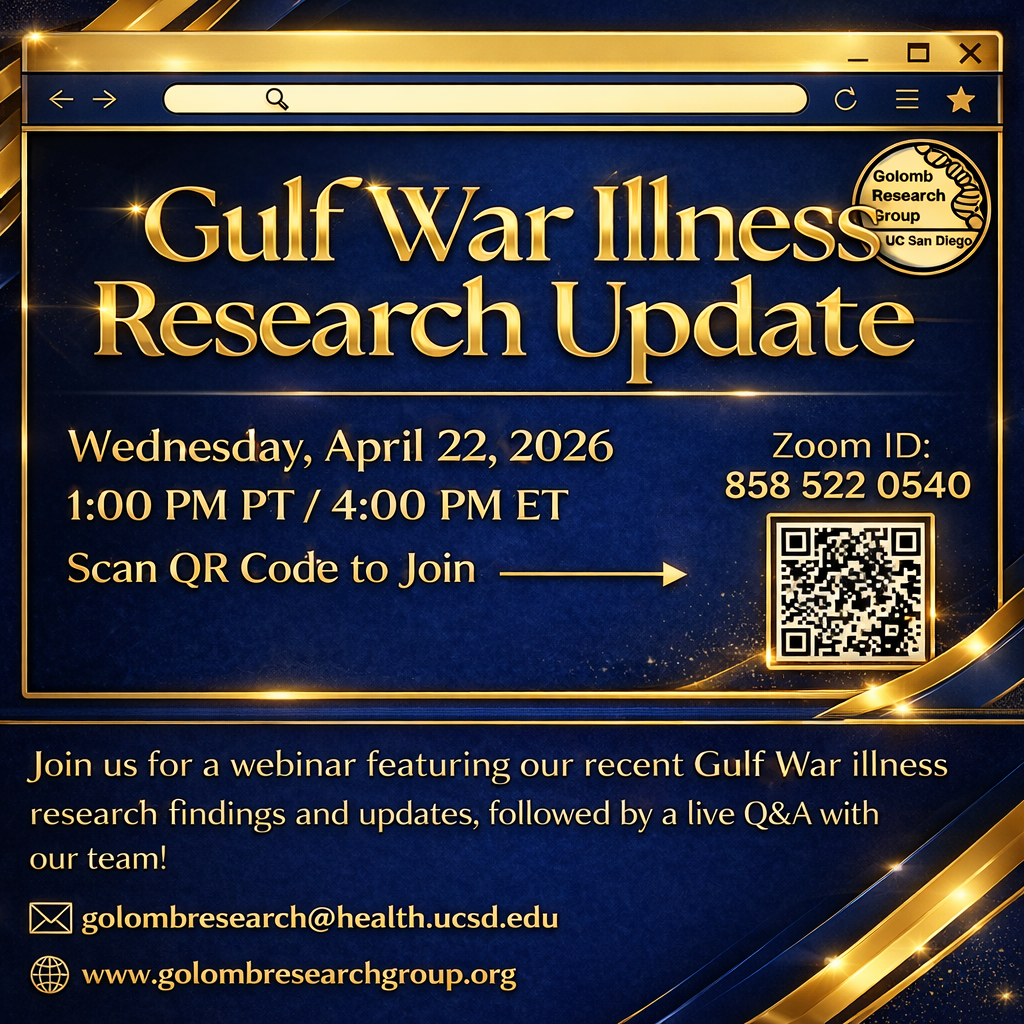
Gulf War Illness Research Update
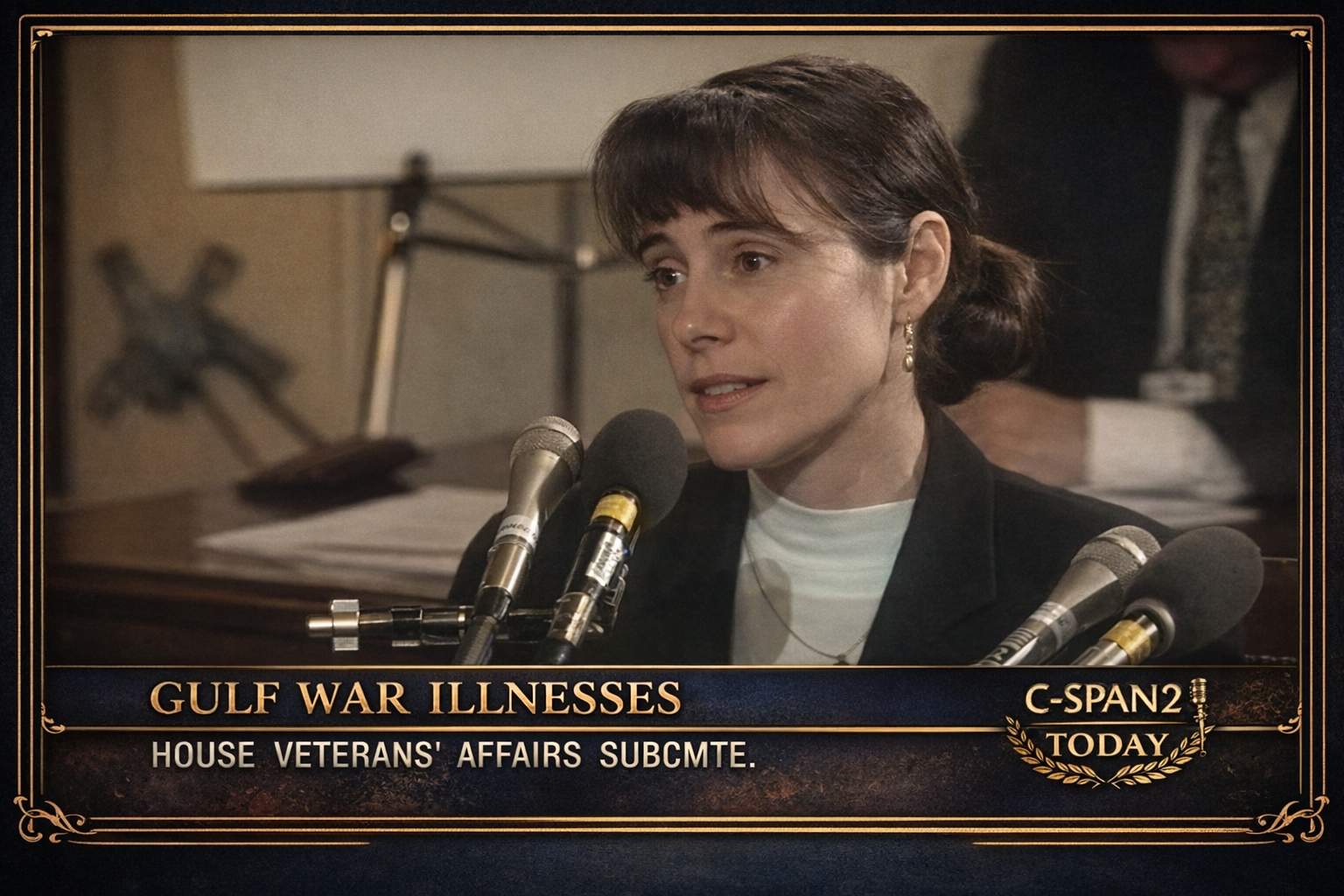
The UC San Diego Golomb Research Group hosted a webinar featuring our recent Gulf War illness research findings and updates on April 22, 2026.
Golomb Research Group Past studies (No longer enrolling)
East Palestine Study
EAST PALESTINE HEALTH EFFECTS STUDY- Enrolling Now!
East Palestine Study
EAST PALESTINE HEALTH EFFECTS STUDY- Enrolling Now!
This study, with Principal Investigator Beatrice Golomb, M.D., Ph.D, aims to gather information from residents of East Palestine, OH, and the surrounding areas which may be essential for documenting a tie (when present) between recent toxic exposures and the emergence of new health problems.
Our study includes optional blood tests and sample archiving, optional wristbands for toxin exposure assessments, and online surveys to document past, current, and future health outcomes.
This study has an NIH Certificate of Confidentiality!
STUDY ELIGIBILITY:
Resident of East Palestine, OH or the surrounding areas (Columbiana County, Beaver County, etc.) during the February 2023 train derailment and subsequent toxin release
Access to the Internet + electronic device such as a computer or smartphone
STUDY PARTICIPATION INCLUDES:
An initial online questionnaire
Completion of follow-up surveys to track future health outcomes
Optional blood tests
Wristband for Environmental Toxin Exposure Assessment (optional for those who qualify)
Mobile phlebotomy (for further immediate testing and storage for future useful tests)
COMMUNITY PARTNERS
If you are interested in being a community partner, we absolutely welcome your input! Please contact us via email at grg-ep@health.ucsd.edu !
PARTCIPATION QR CODE
What to Expect
A small stipend to be mailed after surveys are completed
Lab results shared with you
Community Liaison for questions and ongoing support/communications
Answers to your exposure questions
Learn what actions you can take for your health
TO PARTICIPATE:
Scan the QR code or
Email us at: grg-ep@health.ucsd.edu
Slides from the 2/3/2024 EP study presentation given at the Main Street Theatre in Columbiana, OH
EAST PALESTINE, OH REPORTER
Symptom/Condition/Diagnosis Tracker
The tracker was designed for use by residents of East Palestine, OH and nearby areas to report symptoms, illnesses, and diagnosis that may have started or worsened after the derailment.
You can use the reporter as many times as needed to report new symptoms/conditions/diagnoses.
To report new or worsening symptoms, conditions, diagnosis and/or new medications, FOLLOW SYMPTOM TRACKER LINK OR SCAN THE QR CODE
HELP US FUND THIS STUDY BY MAKING A DONATION ONLINE
Scientific research cannot move forward without support, and donations make that progress possible. Every test, every data point, every piece of medical equipment has a cost—and for many researchers, funding gaps mean important questions go unanswered. Donations empower scientists to keep searching for answers, especially in areas where communities are suffering, but large institutions aren’t paying attention. When people contribute, they aren’t just giving money—they’re fueling hope, discovery, and real change. Research continues because people care enough to help make it happen.
** While some of our research is funded through the Department of Defense, NIH or other sources, not all of the projects we would like to accomplish are funded. We welcome contributions to our research. If you would like to donate, you can do so in two ways.
EP Co Q10
East Palestine, OH Coenzyme Q10 Treatment Study-Enrolling Now!
EP Co Q10
East Palestine, OH Coenzyme Q10 Treatment Study-Enrolling Now!
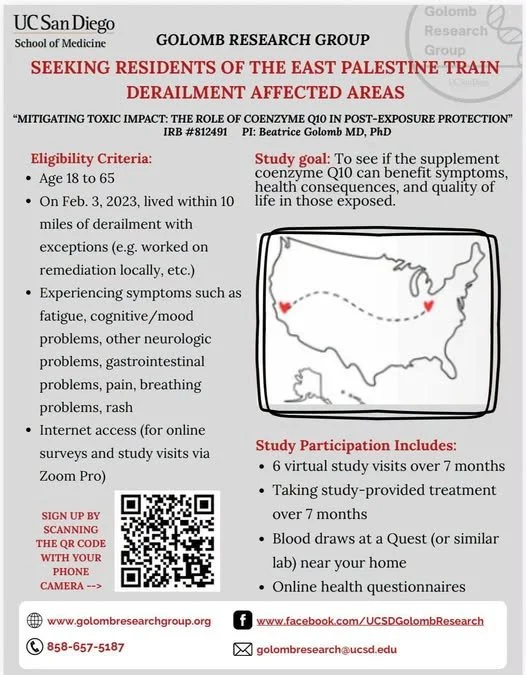
This study will replicate Dr. Beatrice A. Golomb’s previous research study of the same nutritional supplement (Coenzyme Q10) in a larger group of chemically impacted communities. We are trying to determine if coenzyme Q10 might provide benefit to symptoms and objective physical function in East Palestine, OH residents. In a small study conducted by Dr. Golomb, CoQ10 treatment has demonstrated health benefits for affected Gulf War veterans. If the ongoing FDA trial proves successful, we hope it could lead to the treatment being approved for multiple chemical exposures.
Participation Eligibility
On Feb. 3, 2023, lived within 2 miles of derailment with exceptions (e.g. worked on remediation locally, etc.)
Experiencing symptoms such as fatigue, cognitive/mood problems, other neurologic problems, gastrointestinal problems, pain, breathing problems, rash
Internet access (for online surveys and study visits via Zoom Pro)
Signing up for our Q10 Treatment Study is easy and takes less than two minutes!
You can use the link below or scan the QR code to sign up.
East Palestine, OH Q10 Treatment Study
Once you sign up, a welcome email will be sent to you explaining next steps. It will be sent from the email address: Golombresearch@health.ucsd.edu.
NOTE: Be sure to check your junk mail or add the email address to your contacts.
GWI Co Q 10 (Copy)
Coenzyme Q10 for Gulf War Illness: A Replication Study- Enrolling Now
GWI Co Q 10 (Copy)
Coenzyme Q10 for Gulf War Illness: A Replication Study- Enrolling Now
Beatrice Golomb, MD, PhD is conducting a study to assess if Coenzyme Q10 might alleviate symptoms and improve physical function in veterans with Gulf War illness.
We are enrolling Gulf War veterans who:
1. Participated in the 1990-91 Persian Gulf War
2. Are experiencing symptoms that could include (but are not limited to) fatigue, muscle or joint pain, muscle weakness, cognitive or mood problems, and/or gastrointestinal problems etc.
Study participation involves:
1. Study visits conducted via Zoom or telephone.
2. Blood Draws at a Quest or other laboratory facility near your home.
3. Online surveys - we will inquire about your Gulf War deployment and current health status. You can complete the surveys at home using your home computer.
CoQ10 GWI PARTICIPATION
4. Compensation (Visa Gift Card) for your time and effort will be provided upon completion of each study visit.
TO PARTICIPATE:
Scan the QR code or
Email us at: q10study@health.ucsd.edu
For more information, contact our study coordinators at q10study@health.ucsd.edu or (619) 736-7114.

Electrohypersensitivity Study
Electrohypersensitivity Study- Enrolling Now!
Electrohypersensitivity Study
Electrohypersensitivity Study- Enrolling Now!
We are initiating a survey to learn more about electosensitivity- risk factors, triggers, manifestations, etc. We are also interested in finding healthy controls that do not have electrosensitivity (and do not have chemical sensitivity).
Ultimately, we hope to learn from the survey, and also to identify good quality affected individuals and matched healthy unaffected controls, who may be willing to participate in a study, to test biological markers that we believe will elucidate mechanisms of electrohypersensitivity.
If you could share the option to participate with affected (and healthy!) individuals with whom you are in contact, we would be very grateful. (If you know of any other individuals or organization with whom we should communicate to help reach affected individuals, please let us know.)
Warm regards,
Beatrice A. Golomb, MD, PhD
Professor of Medicine
UC San Diego School of Medicine
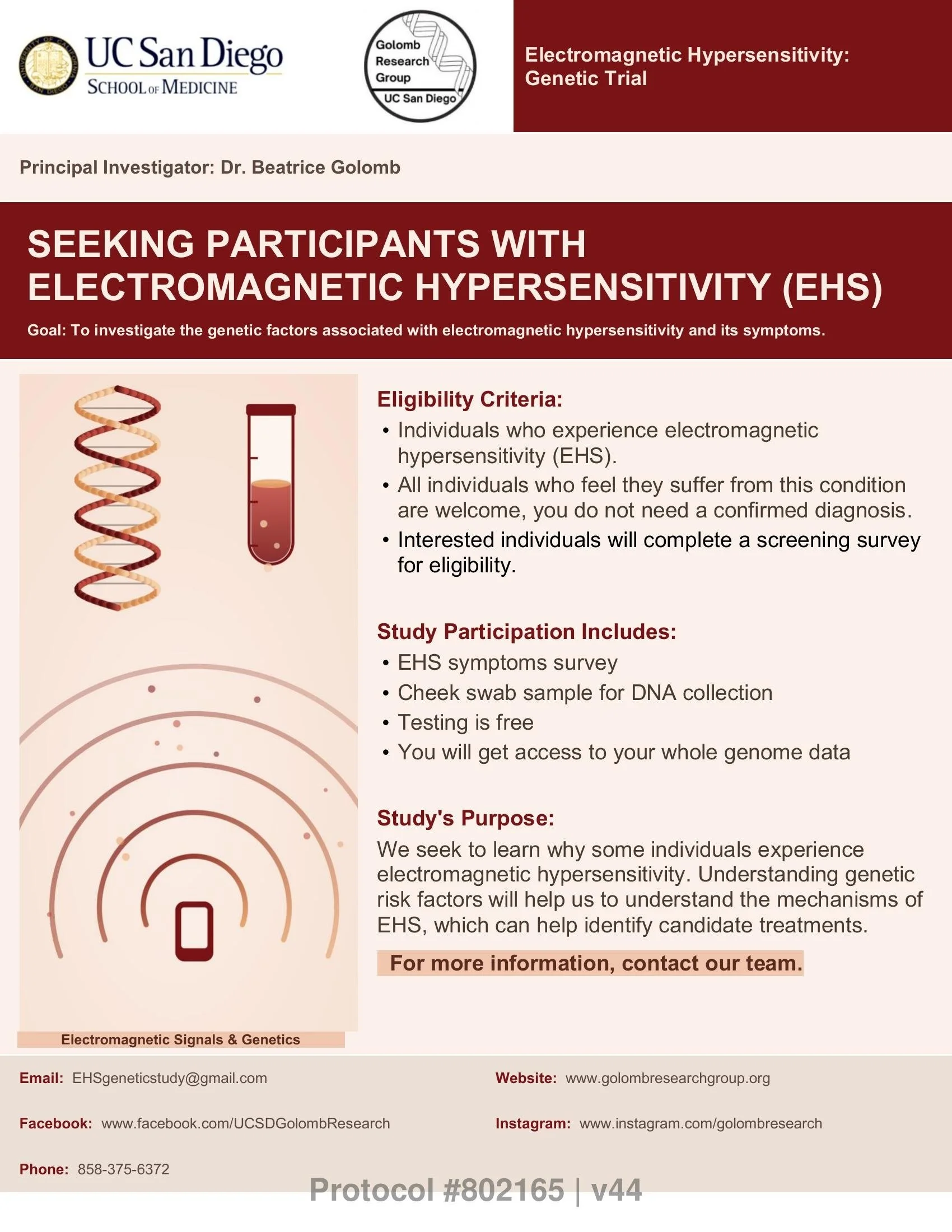
Mitochondrial and Nuclear Genetics Gulf War Study
Mitochondrial and Nuclear Genetics Gulf War Study- Enrolling Now!
Mitochondrial and Nuclear Genetics Gulf War Study
Mitochondrial and Nuclear Genetics Gulf War Study- Enrolling Now!
We are conducting a research study to examine how genes for (and related to) chemical detoxification of Gulf-exposures relate to Gulf War illness risk, severity, and progression.
We invite Gulf War Veterans who were deployed to the Middle East during the 1990-1991 conflict with chronic health symptoms, healthy Gulf War Veterans, and Healthy others (Veteran and Non-Veteran) to participate in the study.
The participation involves one visit to our clinic at our research facility in La Jolla, CA OR at a Quest lab in your area and will last about 1.5-2.5 hours.
The study visit will include:
1) Assessments such as blood pressure, temperature, heart rate, height, and weight.
2) Blood draw; saliva & urine sample.
3) Health Questionnaires.
You will be compensated $25 for your time and travel and can receive your genetic profile through 23andMe at no cost.
Chemical Exposure Survey
Human Health Survey: Chemical Exposure Symptom & Condition Tracker- Enrolling Now
Chemical Exposure Survey
Human Health Survey: Chemical Exposure Symptom & Condition Tracker- Enrolling Now
Purpose of This Survey
This tracker is designed for individuals and families living in areas affected by potential chemical exposure. It allows residents to document symptoms, medical conditions, or diagnoses that may have developed or worsened following a known environmental contamination or chemical release. By collecting this information, we aim to identify community health trends, improve public awareness, and support collective advocacy for medical and environmental action.
Why We’re Collecting This Data
Communities exposed to environmental contaminants often experience ongoing or unexplained health issues long after the initial event. Unfortunately, there is rarely a coordinated effort to track or analyze these patterns. This tracker helps:
Empower residents to document and share their health experiences
Detect trends or clusters of illness in affected areas
Strengthen the community’s case for medical resources, environmental testing, and policy response
Support researchers, healthcare providers, and legal advocates seeking data-driven insight
How Your Data Will Be Used
Your responses may be used to:
Track and map common symptoms or diagnoses over time Identify geographic or demographic patterns of illness
Develop community health reports for public awareness and advocacy
Support requests for medical care, environmental studies, or cleanup actions (With consent)
Share anonymized data with researchers, journalists, or legal representatives investigating community health impacts
Your privacy matters
Your information will never be sold, shared, or used for profit. All data will be stored securely and used only for community health and advocacy purposes. This survey is not a substitute for professional medical care. Please contact a healthcare provider if you are experiencing serious or worsening symptoms. By submitting, you agree that your information may be used anonymously for research and reporting purposes. If you prefer complete anonymity, you may email your report directly to: grg-ep@health.ucsd.edu
Submitting Your Information
You can submit this form: Anytime you experience new or worsening symptoms Multiple times if your health changes over time Each submission helps build a clearer picture of community health impacts.
Gulf War Bioenergetics Study
Gulf War Bioenergetics Study- No Longer Enrolling
Gulf War Bioenergetics Study
Gulf War Bioenergetics Study- No Longer Enrolling
Magnetic Resonance Spectroscopy in Gulf War Veterans and Healthy Controls
This study will compare brain and muscle energetics in Gulf War veterans with Gulf War Illness to those of healthy controls. We will be recruiting both Gulf War veterans and non-veteran controls from the San Diego area. Only one study visit will be required. The procedure is a noninvasive magnetic resonance (MR) study. With MR, there is no radiation exposure, and the study does not involve any medications or injections.

Metabolomics
Metabolomics in Veterans with GWI- No Longer Enrolling
Metabolomics
Metabolomics in Veterans with GWI- No Longer Enrolling
We are conducting a research study to assess whether there are profiles of chemicals or “metabolites” that differ in those with Gulf War Illness vs healthy volunteers using an approach called metabolomics, an assessment which measures multiple chemicals together in the body.
We invite the following groups:
Those with multiple chronic symptoms such as fatigue, pain or cognitive problems:
Veterans
Non-Veterans
AND
Those that are generally healthy:
Gulf War veterans
Non-Veterans
You will be compensated $30 for your time and travel.
Study participation includes one visit to the UC San Diego Clinical and Translational Research Institute (CTRI) in La Jolla, CA.
The study visit will include:
1) Assessments such as blood pressure, heart rate, height and weight
2) Blood and urine sample
3) Health Questionnaires (can be completed at home)
Statin Side Effects
Study of Statin Adverse Events- No Longer Enrolling
Statin Side Effects
Study of Statin Adverse Events- No Longer Enrolling
We would like to learn more about the adverse events that some patients experience taking statins or other cholesterol-lowering drugs. Examples of statins include: Lipitor (atorvastatin), Crestor (rosuvastatin), Zocor (simvastatin), Pravachol (pravastatin), Mevacor (lovastatin), and Lescol (fluvastatin), Baycol (cerivastatin), and Livalon (pitavastatin). And we hope to learn more about the problem and the mechanism, and learn about unexpected benefits.
We are recruiting participants for this study who meet the following criteria:
Users of statin cholesterol lowering drugs who believe that they have experienced an adverse reaction during use and/or after cessation.
If you meet the above criteria, we would like to invite you to participate in this voluntary study so we can further understand the adverse effects of statins.
The study will be conducted via online survey only, so geographic location does not matter for the study. For more information, please email our office at golombresearch@health.ucsd.edu. We would be happy to give you additional information or instructions on how to participate.
Mitococktail
Mitochondrial Cocktail for GWI- No Longer Enrolling
Mitococktail
Mitochondrial Cocktail for GWI- No Longer Enrolling
A new study will assess if a combination of nutritional supplements that improve the function of mitochondria (a “mitochondrial cocktail”) alleviates symptoms in veterans with Gulf War illness. If you are a Gulf War veteran with GWI symptoms, you might qualify to participate. Thank you for your interest in advancing GWI research!

Fluoroquinolone Adverse Events Survey
Study of Fluoroquinolone Adverse Events- No Longer Enrolling
Fluoroquinolone Adverse Events Survey
Study of Fluoroquinolone Adverse Events- No Longer Enrolling
We would like to learn more about the adverse events that some patients experience, and others do not, taking fluoroquinolone antibiotics. Examples of fluoroquinolones include: Cipro or Ciprodex (ciprofloxacin), Levaquin or Tavanic (levofloxacin), Avelox or Vigamox (moxifloxacin), Zymar (gatifloxacin), and Floxin (ofloxacin). We hope to learn why some people have problems with these antibiotics, while many others do not. And we hope to learn more about the problem and the mechanism as well as any unexpected benefits.
We are recruiting 10,000 participants for this study who have taken fluoroquinolone antibiotics, whether:
1) They experienced an adverse reaction during use, and/or after stopping.
-- OR --
2) They have not experienced an adverse reaction (i.e. tolerated fluoroquinolones without apparent problem).
If you meet either of the above criteria, we would like to invite you to participate in this voluntary study so we can further understand the adverse effects of fluoroquinolones.
The study will be conducted via online survey only, so geographic location does not matter for the study. For more information, email our office at golombresearch@health.ucsd.edu. We would be happy to give you additional information or instructions on how to participate.
Mitochondrial and Nuclear Genes Together Determine Gulf War Illness Severity and Symptom Profile
Mitochondrial and Nuclear Genes Together Determine Gulf War Illness Severity and Symptom Profile- No Longer Enrolling
Mitochondrial and Nuclear Genes Together Determine Gulf War Illness Severity and Symptom Profile
Mitochondrial and Nuclear Genes Together Determine Gulf War Illness Severity and Symptom Profile- No Longer Enrolling
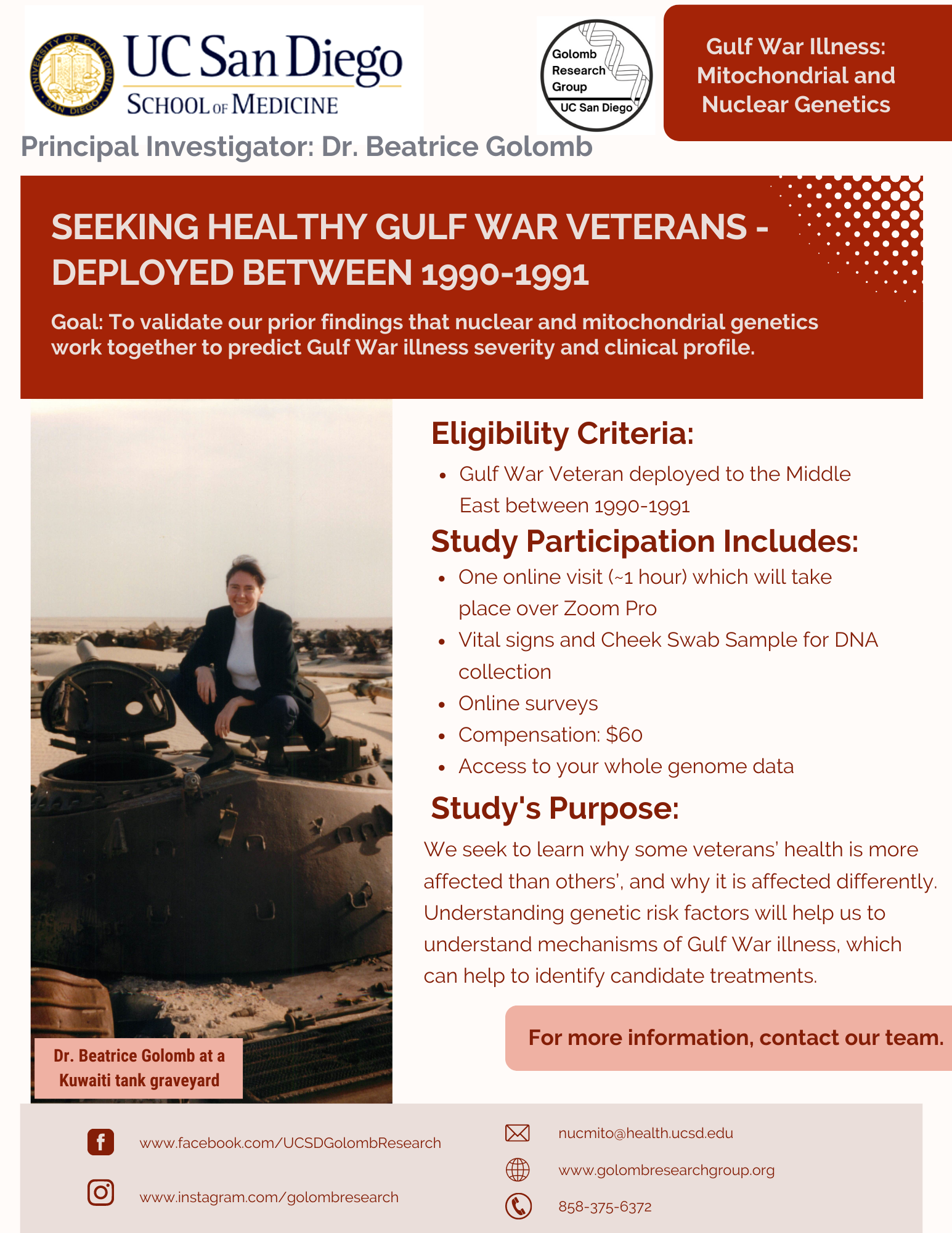
Beatrice A. Golomb, MD, PhD is conducting a research study to help advance our understanding of Gulf War illness and validate our prior findings that nuclear and mitochondrial genetics work together to predict Gulf War illness severity and clinical profile. We seek to learn why some veterans’ health is more affected than others’, and why it is affected differently. Understanding genetic risk factors will help us to understand mechanisms of Gulf War illness, which can help to identify candidate treatments.
We are currently seeking Gulf War veterans nationwide.
To be eligible, veterans must fit the following criteria:
At least 48 years of age
Deployed in the 1990-91 Persian Gulf War
Study participation involves:
One Consent televisit over Zoom Pro.
One Zoom Pro televisit where a cheek swab sample will be collected.
Online surveys – we will inquire about your Gulf War deployment, exposures, and health status. You can complete the surveys at home using your home computer.
Compensation (Visa Gift Card) for your time will be provided upon completion of the study visit.
For more information, contact our study office at 858-375-6372 or email nucmito@health.ucsd.edu
Impact of Physician Attitudes on Healthcare in Veterans with Gulf War Illness
Impact of Physician Attitudes on Healthcare in Veterans with GWI- No Longer Enrolling
Impact of Physician Attitudes on Healthcare in Veterans with Gulf War Illness
Impact of Physician Attitudes on Healthcare in Veterans with GWI- No Longer Enrolling
Beatrice Golomb, MD, PhD is conducting a study that will assess how perceived attitudes of healthcare providers affect veterans with Gulf War illness. The study will examine psychological impact, the veteran’s trust in and return for care to the provider and healthcare system, and the nature of the care is given.
We are enrolling Gulf War veterans who:
1. Participated in the 1990-91 Persian Gulf War
2. Are experiencing symptoms that could include (but are not limited to) fatigue, muscle or joint pain, muscle weakness, cognitive or mood problems, and/or gastrointestinal problems etc.
Study participation involves:
1. Online surveys - we will inquire about your Gulf War deployment, current health status and interactions with healthcare providers. The surveys will take between 1 hour and 1.5 hours of your time. You can complete the surveys at home using your home computer.
2. Compensation of $40 (Visa Gift Card) for your time and effort will be provided upon completion of the survey.

Muscle Mitochondrial Assessments in Gulf War Illness
Muscle Mitochondrial Assessments in Gulf War Illness- No Longer Enrolling
Muscle Mitochondrial Assessments in Gulf War Illness
Muscle Mitochondrial Assessments in Gulf War Illness- No Longer Enrolling
We are conducting a new study: Muscle Mitochondrial Assessments in Gulf War Illness. Mitochondria are an important part of your cells that produce energy so your cells function normally. Using muscle biopsy samples, we hope to assess the mitochondrial abnormalities that do and do not characterize Gulf War illness. Muscle biopsies will be performed by skilled, board-certified Dr. Pamela Taub who has had extensive experience doing this procedure. Dr. Taub will numb the area and remove a tiny bit of muscle. The biopsy procedure takes approximately 20-30 minutes, after which you can immediately return to your daily activities.
We are enrolling study participants who meet the following criteria:
1. Gulf War Veterans: Veterans who participated in the 1990-91 Persian Gulf War and are experiencing symptoms such as (but not limited to) exertional fatigue, muscle pain, and/or muscle weakness.
2. Matched Healthy Non-Veteran Volunteers: Individuals who are:
a. At least 39 years old.
b. Were NOT deployed to the Persian Gulf during the 1990-91 conflict.
Study participation involves up to 3 outpatient visits, to include: a muscle biopsy, blood draws, a respiratory assessment, a light exercise, and health questionnaires. Meals and compensation will be provided upon completion of each visit. A flow chart of the study visits can be found below.
Thank you for your time, we look forward to hearing from you.

Treatments Tried for Gulf War Illness
Treatments Tried for Gulf War Illness- No Longer Enrolling
Treatments Tried for Gulf War Illness
Treatments Tried for Gulf War Illness- No Longer Enrolling
We are conducting a survey study to learn what treatments Gulf War veterans have tried to benefit their Gulf War illness symptoms – and what has worked. This study will seek to understand which treatments are helpful, harmful, or have no impact in easing the symptoms of Gulf War illness. We also welcome input from other veterans with similar problems, to learn how treatment effects differ and to identify other promising treatments.
We are enrolling a total of 1,000 study participants who meet the following criteria:
1. Gulf War veterans: Veterans who were deployed to the Persian Gulf Region July 1990- August 1991 and have experienced health changes (Gulf War illness).
OR
2. Other veterans: Retired members of the military who have had environmental exposures in the military and experienced unexplained chronic multisymptom health changes.
Study participants will complete up to 8 online surveys. Each addresses a different aspect of your treatment experience or symptoms, or asks about factors, like exposures, that may lead to differences in the effect of a treatment. Each survey will take approximately 0.5 – 2 hours. The surveys will ask about your overall heath, well-being, symptoms, exposures, treatments you have tried and their effect, and your healthcare experience.
You can proceed to the next survey either immediately, or a week after a prior survey has been completed (or specify another time to be reminded). After each survey is completed, you will receive a $5 gift card to either Amazon.com or Starbucks (depending on your preference). The more you complete the more you will help.
Thank you for your time—and thank you, in advance, for your help, should you choose to provide it. We look forward to hearing from you.
